 Food for thought – talks and lectures
15:30 Remembering the dead: a sociolinguistic study of Latin, Italian, English and Maltese tombstone inscriptions at the Addolorata Cemetery in Malta
Lydia Sciriha
Department of English, Faculty of Arts
This talk analyses a small selection of tombstone inscriptions in Latin, Italian, English and Maltese at the Addolorata cemetery, Malta’s largest cemetery built by the British in 1859. They reflect the trajectory of Malta’s languages as their function fluctuated in the island’s recent history.
The differential use of different languages and styles traces Malta’s historical landmarks and the culture that sustained them. Before Maltese became co-official with English in 1934, Italian and Latin were used on inscriptions as a sign of prestige. Post-Independence inscriptions are mostly in Maltese, the indigenous language, but inscriptions in English are also frequent especially when owners of the graves wish to show their higher status.
Aspects of past and present social life in Malta, its social stratification and the complexities of social life, all come to life even as one roams within the boundaries of a cemetery.
Despite the silence that enshrines cemeteries, past and present generations constantly engage in a dialogic encounter that confirms the similarities and contrasts of two different cosmologies. The use of languages on the inscriptions is one of the media that enlivens this encounter.
Duration: 40 minutes
Location: Library, Second Floor
13:30 Interpreting for the EU
Amy Colman, Peter Mifsud
The European Union depends on interpreters for many of its meetings, Amy Colman, from the Department of Translation, Terminology & Interpreting Studies, and Peter Mifsud, from the European Commission’s Directorate-General for Interpretation (SCIC), tell us how this works.
Duration: 60 minutes
Location: Room 4, Ground Floor
14:30 Swearing around the world: how languages let off steam
Dr Jessica Nieder
Why do people swear, and do we all do it the same way? This fun, family-friendly talk explores how languages around the world let off steam! Drawing on research from linguistics and psychology, Dr Jessica Nieder takes you on a cross-cultural journey to discover how emotions like anger are expressed across different languages — and what sounds make a word feel “powerful.” From the science of the kiki/bouba effect to Maltese food-based insults, you’ll learn why swearing can unite us, how it differs across cultures, and why even taboo words play an important role in human communication. No bad words will be spoken — just plenty of laughter, insight, and linguistic surprises!
Duration: 60 minutes
Location: Library, First Floor
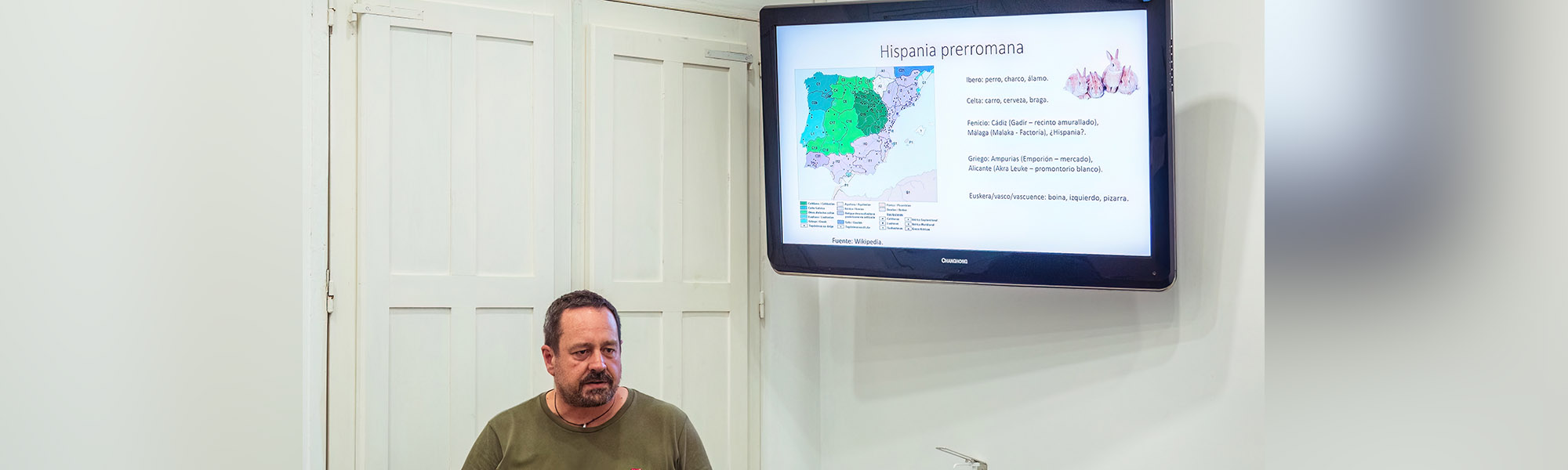
16:00 A brief history of the Spanish language
Pedro Santamaría
Writer Pedro Santamaría walks us – or runs us – through the history of one of the world’s most widely spoken languages.
Duration: 45 minutes
Location: Room 4, Ground Floor